Exclusively Inclusive.
By Karen Brain
What do you think of when asked, “What is your community?” It’s often categorized by race, religion, sexual orientation, and other characteristics of shared identity. But community can also mean shared goals, like allies. As someone who has lived with a disability for most of my life, this is how I primarily define my community.
I loved watching Mister Rogers’ Neighborhood on TV as a kid. He famously said, “When I was a boy and I would see scary things in the news, my mother would say to me, ‘Look for the helpers. You will always find people who are helping.’” To me, helpers are my community.
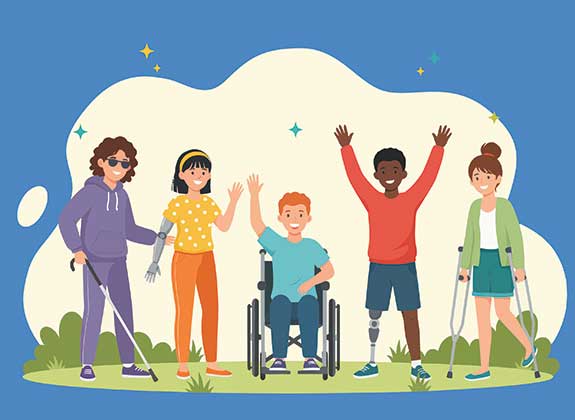
Those helpers are my village. The proverb “It takes a village” usually implies that raising a child is a communal responsibility. In the same way, it takes a village of helpers for people with disabilities to thrive in a world not designed for us. These are some of my helpers:
Friends and Family
Let’s start with the obvious: family. Or so we think. This assumes the family is willing to help. Sometimes there is no family, and sometimes they choose not to help. Unfortunately, this happens often to people with disabilities.
Because of this reality, recognizing that family can be intentionally built. Choosing our loved ones is a transformative realization for many. It might mean excluding our biological family to build a new one, if members are harmful to us, for example. Or we could expand our family, like including close friends or caregivers.
Maybe how we choose members depends on how we define love. For me, actions always speak louder than words. While family is extremely important to me, history, traditions, and biology do not guarantee membership.
Like choosing family, choosing friends is a significant quality-of-life decision. While chemistry and shared interests are important, building a sustainable inner circle requires a more intentional approach. This is especially true for vulnerable populations, like people with disabilities.
Adversity acts as a filter for human relationships. It shows loved ones’ capabilities, regardless of your expectations or what they tell you they can do. If they can’t “show up” in the way you need or want, it doesn’t mean they’re a terrible person or the relationship is doomed. While disappointing, this discovery is actually a blessing, an opportunity to reassess the relationship appropriately.
The reality of that filter becomes most apparent during our most vulnerable moments. When recovering from surgery or an accident, who are you comfortable with performing personal tasks like toileting, showering, dressing, and feeding? Not just getting you to the toilet or bringing you food, I’m talking about someone physically performing these tasks for your body because you can’t. More importantly, are they comfortable and capable of doing it well?
Crises can happen at any time to anyone, requiring a total shift in priorities. So, who can you call? It might take more than one person. These are the helpers; the ones who passed the “filter,” and they are a vital part of my community.
ADA Compliance and Inclusion for People with Disabilities
The Americans with Disabilities Act (ADA) is a federal civil rights law enacted in 1990 to provide access for, and prohibit discrimination against, people with disabilities. The ADA is a blessing, no doubt. But it’s lacking in many ways, criticized for being reactive rather than proactive, and has several gaps that prevent it from achieving true equity. Do I have high expectations for improvement, or is the ADA a low bar (with a lack of enforcement making it even lower)?
In addition to ADA compliance, taking action to be inclusive of people with disabilities is ideal, as ADA compliance and inclusion are related but different actions. For example, ADA law requires emergency services, programs, and activities to be accessible. This includes Areas of Refuge and Rescue Assistance, which are fire-resistant spots requiring specific fire-rating and communication systems where people who cannot evacuate independently can wait for emergency responders.
In 2010, I worked on the seventh floor, and during the fire drill, I was told, “Because you can’t do stairs, you must wait in the stairwell until you can be rescued.” Nope. I’m not waiting to see if I might be rescued in time. (Plus, I seriously doubt our stairwell was an ADA-compliant Area of Refuge.) As far as I could tell, our only option would be to hop on someone’s back like Yoda as they went downstairs, or start packing our own parachutes. For future planning, I suggested a trampoline or bounce house to cushion our plunge from the window. Because if we’re using ridiculous solutions, let’s make them fun. Standing in the stairwell remained their “solution” for us for several years, no matter how much I tried to brainstorm or negotiate with them. We never saw a change to their ridiculous plan.
“Stair chairs” have been mass-produced since the 1970s. They’re portable, mobile devices used to safely transport people up or down stairs when elevators are unavailable, as in the evacuation of the World Trade Center on September 11, 2001. (As opposed to a stair lift, which is a permanent mechanical chair installed along a staircase, as we saw in the movie Gremlins.) Today’s versions typically cost as little as $150 and are available through major online retailers and medical supply stores.
This was one solution I proposed to my employer. It’s an example of better inclusion for people with disabilities (although not as fun as a bounce house). But I was told no; a response representative of a larger, systemic comfort with exclusion.
Another example of inclusion is to ensure people with disabilities are on planning committees. We’ve learned that including representatives of target populations in development and operations provides more effective and sustainable results. This idea, known as Participatory or User-Centered Design, has been mainstream for over 20 years. Yet it’s not commonly utilized for people with disabilities. If providing products, services, or programs designed for humans, disability communities should be included at every stage of their life cycle, as we are in every community. Not doing so is like asking only white, straight, cisgender men to design and operate a program to serve transgender youth. Or asking an accountant to perform heart surgery. What are you doing? Stop it.
Inclusion isn’t just about physical safety in a crisis; it’s about everyday access to decision-making. The COVID-19 pandemic proved that adaptation could happen; virtual access is possible. Choosing in-person-only models is a deliberate exclusion of those requiring a virtual option. Whether intentional or an oversight, denying this sends a clear message to those who need it: you are not valued, and you do not belong.
It suggests inclusion during the pandemic was just a temporary break from the norm, not a push for lasting change. To those who finally had a seat at the table, it feels like our seat was never meant to be permanent. Like physical presence is the only true form of engagement, and if you can’t, you don’t matter. When leadership makes this choice, it frames the organization as a private club that values outdated traditions over innovation and equity, despite its mission statement or advertisements that tell us otherwise. Requiring special accommodations for virtual access forces individuals to “out” themselves in the workplace. Leaders who remain silent appear to endorse these choices.
In addition to access concerns, people learn and receive information best in different ways. The solution is a hybrid design: offer both in-person and virtual options, proactively list these choices in the invitation, and provide a clear point of contact for any questions. When neither option is offered, advocate for it; don’t remain silent. I perceive those who are ADA compliant and work towards greater inclusion for people with disabilities to be my community members.
E-Commerce, Service Providers, and Home Delivery Services
The pandemic-era boom in e-commerce and home delivery services wasn’t just a convenience for the general public; it was a lifeline for those who are immunocompromised or have limited mobility, making independent living significantly more attainable. Having shopping done for me with a click of a button is invaluable. Prior to 2020, my independent shopping ranged from nearly impossible to actually impossible. While the pandemic was a global tragedy, for those in my position, it also offered an unexpected sense of freedom. I consider these unaware allies who make these services possible to be part of my community.
Artists are also extremely important to me, just as much as other service providers. Painters, dancers, actors, musicians, all of the above. The arts are so healing. It gives me peace; it takes my mind off difficult situations or gives me the strength to endure those that seem impossible to overcome. Nowadays, when the news seems so scary, I turn to art.
Another critical group is healthcare professionals. I attribute much of my physical mobility to the exceptional healthcare professionals I’ve had the privilege of working with throughout my life. Their impact extends beyond successful interventions; it’s about maintaining and restoring independence.
Living with a disability means facing a world of obstacles and poor accessibility while also managing the pain and circumstances of the condition itself. These professionals: physicians, nurses, therapists, specialists, etc., do not simply fix a mechanical issue. They have consistently bridged the gap between what my body can do and what my spirit wants to do.
However, while the individuals are exceptional, the environments they work in often create the very obstacles they’re trying to help us overcome. For example, there is one healthcare facility I use for multiple services (specialists, pharmacy, radiology, phlebotomy, urgent care, etc.), which opened in 2013. While it’s nice to have one location for so many services, their three-level parking structure with approximately 300 spaces has four disabled or accessible parking spaces. Really?! That’s not ADA-compliant. It’s a glaring lack of inclusion for a group likely to be a significant portion of their clientele. Who made that decision? Not someone with limited mobility.
Other problematic examples include medical offices without an automatic door or a push-to-open activation switch, or without a wheelchair-accessible reception countertop, or inaccessible bathroom sinks and soap dispensers mounted too high for reach (apparently, clean hands are not a priority in those locations). To truly support their work, we must improve the choices made regarding facilities and operations. Including people with disabilities in decision-making could prevent such problems and save legal, remodeling, or repair costs; I consider those who do so to be my helpers.
Finding the Allies
I have found a deep sense of camaraderie between the LGBTQ+ and disability communities. As allies, we share many of the same systemic and social barriers, which are reflections of a deeper social issue: “othering.” Our communities share specific emotional frameworks, from the burdens of marginalization to the powerful resilience found in collective support.
While many marginalized groups share these experiences, a few of our specific overlaps include:
- Fighting for bodily autonomy: Rejecting the idea that we are broken or need to be fixed.
- Shared social stigmas: Navigating objectification, desexualization, and dehumanization.
- Interpersonal struggles: Facing rejection, pity, or shame from loved ones.
- The Closet and Masking: The constant need for safe spaces and the heavy burden of explanation.
- Internalized barriers: Combatting ableism, queerphobias, and the imposter feeling.
- The fight for visibility: Addressing workplace discrimination, legal barriers, and the lack of representation.
When “othering” is used as a leadership strategy to enforce assimilation, true community becomes our greatest act of resistance. This community is made when we prioritize a common purpose over common backgrounds. As our doors open to those we may have previously overlooked, we realize our world is far larger than we imagined. Together, we build greater resilience; perhaps then the label of “other” can finally begin to fade. To expand on the words of the great Mr. Rogers: Look for the allies. You will always find allies.
As we celebrate International Pride Month this June, find your allies and stay safe. Happy Pride!
This article was originally published in the 2026 PRIDE Month & Community Issue of Las Vegas PRIDE Magazine, and can be read in its original format here.