
Exclusively Inclusive.
By Karen Brain
When did the traditional school year start date change to August? In some cases, late July? I remember school always starting the day after Labor Day. We only had Thursday and Friday off for Thanksgiving, two weeks off for winter break, and one week for spring break. In my hometown, San Diego, our schools didn’t have anything like “inclement weather days,” which was because we didn’t have “weather”. Not having significant seasonal weather changes like many other places made San Diego a great place to live for someone like me, living with arthritis.
As I mentioned in my Spring 2023 article, I was diagnosed with an autoimmune disease called Juvenile Rheumatoid Arthritis at age 1½. I spent a third of my childhood in the Los Angeles Children’s Hospital, starting at age 3. We called it going to Rehab. The impact of arthritis on my education, both positive and negative, started in preschool. There are several positive and negative experiences; I cannot write about all of them here, so I’ll pick a few.
Preschool (ages 3-4) was a positive experience for me. If there were things I couldn’t do independently because of my arthritis, my teachers or their aides would help me. Assistance wasn’t needed often, but when it was, it was never an issue.
Kindergarten, on the other hand, was a different story. In my June 2024 article, I wrote about my experience, which had a profound and painful impact. The effortless assistance in preschool felt like an extraordinary imposition once in kindergarten. There, my teacher punished me for not being able to do the physical things my able-bodied peers did. When I ran into her years later, she acted like the negative experiences never happened. Yet she remembered I had arthritis and seemed to want to bond over her own recent arthritic experiences. I was surprised by her actions. I was also surprised she was still alive; she was no spring chicken when we initially met. She must have eaten children to maintain her youthful glow. I explained to her that the way she treated me back then was traumatic and also likely affected how my peers viewed disabilities. I ended our conversation by saying, “Every time you’re in arthritic pain, I want you to think about me sitting in the back of your class alone, crying, and remember you put me there because of my arthritis.”
I loved to roller skate as a kid. But like most physical activities I was able to do, I soon discovered the risks and costs of getting hurt outweighed anything else. One day, my class took a field trip to go roller skating, but I wasn’t allowed to go. I don’t remember whether it was the school or my parents who decided I couldn’t go due to my arthritis. I was furious! So my dad took me to see Ghostbusters (the original) in the theater instead. Fair trade. It’s a great movie.
After my roller-skating period, I entered my skateboarding period. My skateboard had handlebars like a scooter, but on a skateboard. I traded my roller skates for my Scoot Skate, as I called it, which provided a little more stability. Suddenly, I shopped at skate and surf shops and wore nothing on my feet but Vans. (Vans were the only shoes I could find to fit my foot splint AND foot in the shoe, and were stylish enough that I didn’t feel like I was wearing my grandma’s shoes. Why are accessible shoes usually so ugly?!) I felt very cool. I look back at pictures now and think my poodle perm ruined the look, though. Eventually, the perm grew out, but the Vans have stuck with me for life.
Then there was the sixth-grade camp; a weeklong stink fest. Of course, I had to go shopping before that adventure. I didn’t know what I was in for, but I needed to ensure I had clothes and materials that would allow me to function as independently as possible. If I didn’t already have it at home, hopefully I could buy it so I could go to the bathroom, shower, and dress myself at camp. Luckily, I had friends who liked to do my hair; that helped. But there was one thing I didn’t consider: we were only allowed to take 5-minute showers and were not allowed to use shampoo. Clearly, these adults were joking or insane. I had smelled some of my peers who stunk on a good “I showered within the last 24 hours” kind of day. Now this stink trip would allow them not to take a real shower? For a week?! I genuinely question the 5-minute shower for people of all ages. I have lived long enough to know some human parts and crevices need a good scrubbing regularly. I realize I take longer than the average to shower due to my disability. Still, I think anyone who tells me they can shower their entire body in 5 minutes is probably lying or living with dirty bits. I was so happy to go home at the end of that week. I felt the need to burn my camping clothes and sleeping gear. Detergent would not suffice; fire was necessary.
My visits to the hospital were several weeks or months at a time, usually during my summer breaks from school. But sometimes the school year included periods of hospitalization, during which I completed studies and assignments, allowing me to keep up with my class and not be held back. Hospitalizations during the school year only occurred during elementary school. By Junior High, my visits were for joint replacement surgeries during my summer breaks, starting with a hip replacement at age 12.
My hospital visit during one year in Junior High was for a different reason: I got chickenpox. Due to my arthritis medication suppressing my immune system, I catch illnesses more easily than most, and they are usually more severe and last much longer. My chickenpox adventure was severe and lasted for a month. Again, my school assignments were completed.
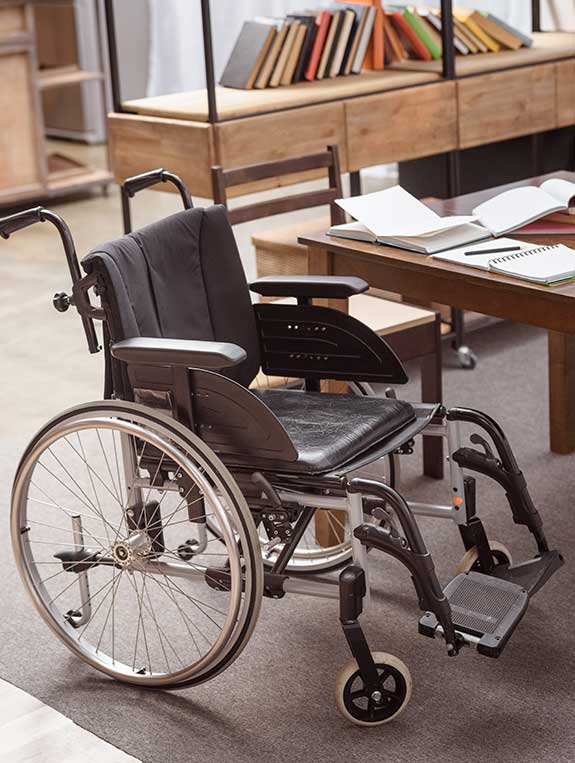
My eighth-grade class was offered a week-long trip to various historical East Coast locations. (“Offered” meant the school organized it, and we paid for our trip.) To make me feel more comfortable and safer on the trip, my mom joined us as a chaperone. We brought my wheelchair because I cannot stand for long periods or walk for long distances. After the trip, our assignment was to write a report about it.
Overall, I had a great time with my friends and I learned a lot. Of the many things I learned, the widespread ignorance surrounding disability was particularly striking, which seemed to fuel both ableist attitudes and inaccessibility, and in some cases, a reluctance to engage with individuals with disabilities. Each time we experienced this, Mom would speak up and advocate for me, while I became sad, quiet, and wanted to hide. Here’s just one example of many during that trip:
We visited the White House. Our whole group was standing in line outside waiting to take a tour. I was with them in line, sitting in my wheelchair, with Mom standing in line behind me. A security guard approached us and said I had to leave the group because I was in a wheelchair. Mom tried to explain that we were with the school group, and that it was part of our history project, which I had to write a report about, etc. To which he said, “Doesn’t matter. She’s in a wheelchair. Wheelchairs can’t go on the tour.” Mom asked why, but he just kept repeating, “Wheelchairs can’t go on the tour.”
Maybe he meant the White House was not wheelchair accessible. But he never said that. The internet tells me now the White House became wheelchair accessible almost 20 years before my visit. It says the residents of the White House back then were committed to making “the People’s House” accessible. Could the internet share incomplete or incorrect information? Could politicians lie or fail to meet their commitments? If the White House became accessible so long ago, why was I told repeatedly during my visit that wheelchairs couldn’t go on the public tour? Maybe he meant sections of the tour were under construction, and therefore not accessible at that time. But he never said that either. To be clear, none of those reasons would have been acceptable to Mom.
She continued to question him. She even offered to stand outside with my wheelchair if they’d let me take the tour with my group, and I stood up to show him I could walk independently. But none of that seemed to matter. (Honestly, if my ability to walk suddenly made the difference, I’d be pissed.) I could see my peers watching this show, their eyes glued as if we were a train wreck, and I could feel my shame and embarrassment increase by the minute. I asked Mom to stop. This was one time when I thought I might have some control to stop the stares, and at this point, I didn’t want to see that stupid White House anymore. I wanted the spotlight off of me; I was tired of being the train wreck just for being me.
Mom and I followed him to take “our tour,” Me in my wheelchair, head hanging, looking at the ground. Mom was angrily pushing my chair, and this guy was casually guiding us around back, just like it was any other Thursday. He brought us to an entrance near the dumpsters and showed us a couple of rooms. Then we sat outside waiting for our group.
When it came time to write my report, I asked friends for their notes. Even though the entire group saw I didn’t get to take the tour, including the history teachers who were chaperones and grading our reports, I wrote my report on every part of that tour as if I had been there, because I didn’t want to say I wasn’t allowed to go because the tour of “the People’s House” wasn’t made to include people like me. I wish I had added to my report, “Why was Mom the only one advocating for my inclusion?”
Much like in kindergarten, my Individualized Educational Plan (IEP) throughout my education was used more to prevent adults from denying me access to what my peers already had than it was for any “special” services. Once I was in Junior High, we added a few extra minutes to passing periods for me to get from classroom to classroom, and a second set of books to have one at home and one in my classes, so I didn’t have to carry books.
In High School, I started driving at 16 because I had many medical appointments, and I worked after school. I got called into the office and questioned about why I kept parking in the teacher parking lot. I explained I couldn’t find any disabled/accessible parking spaces in the student lot (because they didn’t exist). Soon after, they added a few blue spots in the student lot.
Having a car allowed more independence. Having a hooptie car allowed for more crises. Once, my car died in the middle of a very large and busy four-way intersection. My car was filled with four disabled girls; three whose power wheelchairs were left at home, and me. Nobody stopped to help us; I had to walk to the nearest phone to call for help. After that, I got a cell phone.

There are many more adventures during my high school and college years, but I’ll have to save those for another article! While some of my educational experiences were difficult, if they had to happen, I am grateful for the lessons they’ve taught me about humanity and myself. They helped shape who I am today. Hope all of you who are in school now, have kids in school, or work at a school have a great year!

This article was originally published in the 2025 PRIDE Celebration Issue of Las Vegas PRIDE Magazine, and can be read in its original format here.