Exclusively Inclusive.
By Karen Brain
When I think of summer, attending mass attractions comes to mind—such as theme parks, Comic-Con, Pride, and concerts. The relationship between my physical disability and my participation in mass attractions is entirely interactional. My diagnosis does not define my ability to engage with the event, but by how my disability intersects with both the physical environment (is it accessible?) and the social environment (how do those around me perceive disability?). To illustrate, here are a few of my experiences (admittedly, some by my choice, and some not):
Theme Parks
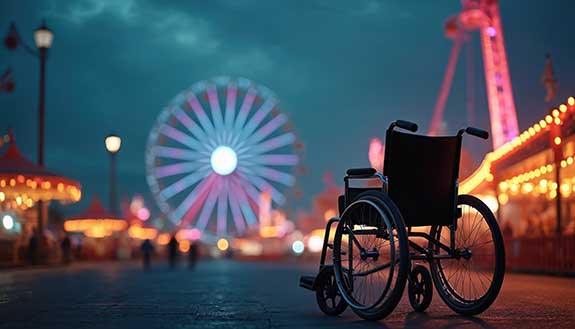
Places like this attract a global crowd with diverse attitudes and beliefs about disability. Most of my experiences have been positive. But on the scale of strangers’ negative behaviors, at best, I deal with them staring at me. At worst, I face blatant disgust, fear that my condition (arthritis) is contagious, or behavior suggesting my life has no value. While my friends get furious on my behalf, I try not to show any outrage myself. Instead, I use my Resting Nice Face. Living with a physical disability my whole life means these negative behaviors aren’t new to me.
Anger isn’t helpful. Instead, I tell my friends, “Let them stare. Maybe they’ll learn something.” While it isn’t my responsibility to educate others, doing so defuses the immediate situation and helps the disability community long-term, especially since people often (unfairly) view one disabled individual as a representative for the whole community.
Getting on rides brings a different set of challenges. Many think it’s a perk to “cut” the line as a wheelchair user, but it’s actually anxiety-provoking. I would much prefer an accessible ride, which includes the line. Sometimes both guests and staff get angry if the ride has to be stopped for me. The worst anxiety comes from not knowing if a ride is actually accessible until I’m up there to try it. If I realize I can’t board, the crowd’s frustration becomes even more palpable. Things I’ve heard them say to me from the line include, “Must be nice to go to the front and not have to stand in line.” Or “Wish I could just jump the line.” My favorite response to say is, “Let’s trade spots, you live with this disability for your whole life, and I’ll stand in line for this ride.” (Bonus if I can say it with a Resting Nice Face.) Their anger highlights their privilege; they have no idea what it’s like living with a disability. Instead of misdirecting their frustration at me, who is simply trying to navigate the space, they should be blaming the venue for its inaccessible, exclusionary design. Imagine paying an expensive admission fee only to discover whether a park is accessible through trial and error, while dealing with angry strangers. That’s a costly gamble.
When theme parks remodel or expand, they should prioritize universal design (UD) and include people with disabilities in the planning process. Building barrier-free environments from the start eliminates the need for costly future retrofits. Ultimately, true accessibility benefits guests and the business alike, as it directly correlates with increased attendance and revenue. (Other industries adopting universal design experience these same benefits, too!)
Comic-Con
San Diego Comic-Con International (SDCC) is one of the biggest mass attractions I’ve attended. The Internet reports roughly 300,000 people attend, with half inside the convention center and half outside. Inside the Exhibit Hall, it’s shoulder-to-shoulder. (Summer sweat and smells can be revolting.) But as a wheelchair user in a crowded space, shoulders aren’t what I’m getting up close and personal with. Public Service Announcement: Look behind you before backing up. Please, for the love of my face, look behind you!
One year, we found ourselves in the center of a celebrity sighting. Unbeknownst to us, the entire cast from a very popular show was about to be in our location. Security tried to clear a path for the cast. This alerted the crowd to the possibility of being within arm’s reach of their favorite actors. We witnessed a sharp split in the crowd between those who view people with disabilities as valueless and those outraged by that very premise. Desperate for a glimpse, some onlookers actually climbed onto my lap in my wheelchair, like a step stool, standing on my body. Instantly, kind strangers helped my husband push them off of me and yelled at them.
In addition to acting as my bodyguard, my husband is my caregiver when needed. When single-user bathrooms (also known as all-gender or family bathrooms) are not available, and the only accessible toilet is the “big stall” at the end of the row of public toilets, then he’s coming with me into that public bathroom. If there’s a waiting line, then we’re in line together with everyone else. This is another situation in which we can see a crowd split between those who understand our situation and those who object. To be clear, he keeps his eyes on me or on the floor. Yet Comic-Con is the only place where someone has asked him to leave. He calmly refused. I am his wife; I needed help, so he helped me. If a single-user bathroom had been available, we would have used it.
Pride Events
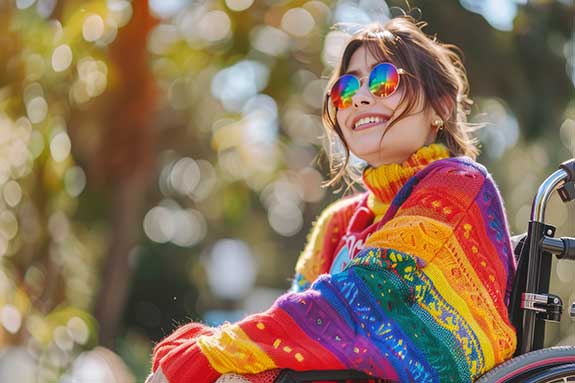
Speaking of bathrooms, let’s address the worst option: the porta-potty. Who designed this monstrosity? Not someone with a mobility disability. Invented in the 1940s, it’s mind-boggling that this is still the best we can do at events like Pride. I’d almost rather suffer a bladder infection than use a porta-potty. At events involving drinking and celebrating, navigating porta-potties becomes a real-life game of Operation, where I must make contortionist moves to try and get the bodily function in the cesspool hole without contaminating myself. Plus, the makeshift sink is always out of soap. If you just used the porta-potty, I’m definitely not shaking your hand or hugging you!
So I have to decide if it’s worth it. What are the chances I’ll have to go to the bathroom while I’m celebrating Pride, and is it worth it for the price to attend? When I was in my 20s and 30s, I attended Pride every year. Since then, I have more physical limitations, I’m less impressed by overpriced drinks and greasy foods, and, most importantly, by those who consume them and mess up the bathrooms! I consider my options, and sometimes it’s not worth the cost. But I’ll admit, I’ve never regretted attending Pride! At least not that I can remember.
Concerts
My introduction to “accessible seating” was at my first concert at The Murph (San Diego Jack Murphy Stadium, which no longer exists). My best friend used a power wheelchair, and we saw Pink Floyd with our boyfriends. I couldn’t understand why we were limited to one (substandard) seating option for the same high price others paid for better options. It lacked “companion seating,” providing only a single chair and space for a wheelchair, because the designers didn’t consider that a wheelchair user might attend with more than one person, or that multiple wheelchair users might attend a single event. The terrible sightline (unable to see the stage from our location, and fans frequently stood up in front of us) meant listening to cool music while staring at a show of dancing butts. That was if we could get to our seats and last for the entire concert, given the lack of accessible ramps and bathrooms at this stadium. Imagine paying for your concert ticket, not knowing whether you’ll be able to see the show, get to your seat, or whether your party will be able to sit with you, and that you probably cannot go to the bathroom until you return home. Is that worth the same ticket price others pay? Modern venues are still repeating these mistakes.
Years later, I accepted a coworker’s invitation to watch a concert at Humphrey’s for free from their boat. I should have asked more questions about this free plan. Instead, I hopped in their car, and away we went.
Close to the venue, we stopped at a gas station, but not for gasoline. Turned out, by “boat,” they meant “inflatable dinghy.” How would I get in or out of a dinghy?! I’m going to die, I thought to myself. I was not “out” at work about my disability. Yet there I was, in their car, on their able-bodied adventure.
Then came the next hurdle: wading through a marshy area underneath a restaurant, followed by a laborious climb into the dinghy. The best I could do was lie flat on my back on the bottom of the dinghy with my legs hanging over the edge, staring up at the sky. Any attempt to move into a different position was unsuccessful. It wasn’t the worst thing in the world to listen to the concert while staring at the stars. No, the worst thing was trying to get out of the dinghy. But somehow, we all survived.
Company Picnic
Years ago, my then-employer invited all employees and their families to the annual summer picnic. I dressed intentionally: pockets instead of a purse, and shoes to make walking on grass as easy as possible. (Grass is dangerous ground for me, a high risk of falling and breaking my fragile bones.) That year, they had an inflated Mega Bounce House. I decided I needed to try it. I was 4’9”, the size of some kids in there, and I thought it would be a fun (or funny) adventure. It did not disappoint.
The entrance was a large, inflated tube. While smaller kids ran through it, the bigger kids leaped into the tube and usually made it all the way through, into the connected room of plastic balls and net walls. I decided that would be my approach: leap through it. I had never leaped before in my life, and it should have stayed that way. But a combo of FOMO (fear of missing out) and Imposter Syndrome motivated me to go for it. I took off my shoes and leaped!
I landed perfectly stuck: my body from the knees up was inside the tube, while my lower legs were still outside, but unable to touch the ground. To make matters worse, children kept entering by climbing right over me, stepping on my body and hair. Eventually, I fell into the sea of balls. I emerged with static-volumized hair, my keys fell out of my pocket, and I lost a sock. Trying to retrieve them felt like drowning more with each move I made. Luckily, my coworkers rescued me. And to think, I thought grass would be my greatest threat that day. I don’t do Bounce Houses anymore.
Human Choices
The intersection of disability with both the physical environment (accessibility) and the social environment (public perception) is ultimately shaped by human choices. When I witness blatant, negative behaviors, I wonder where people learned them and why they think they are okay. I believe disability awareness should be integrated into formal education. It is our collective responsibility to teach kids, formally or informally, about the full spectrum of human diversity. After all, disability is a human condition we’ll all experience someday, whether temporary or permanent, short-term or long-term. For those who do not live in a diverse community, these insights are easily found online.
Cultivating an inclusive world requires an intentional effort to shape our physical and social landscapes. While modified infrastructure ensures access, educating minds through formal and informal learning is what truly dismantles social barriers. This task is best begun with children, who naturally embrace human differences. Proactively teaching on the realities of disability moves us away from accidental exclusion and toward a consciously designed, empathetic society.
Despite the challenges I’ve shared, I am grateful for the many positive adventures where strangers seamlessly stepped in to help. (I wonder where they learned that behavior, too.) Whatever adventures you choose this summer, I hope they are safe, inclusive, and fun!
This article was originally published in the 2026 Summer, Arts & Entertainment issue of Las Vegas PRIDE Magazine, and can be read in its original format here.