
Exclusively Inclusive.
By Karen Brain
A wise woman once told me, “We never really lose a loved one. They’re always with us. Sometimes they can do more for us from Heaven than they could on Earth.”
I was shaped by a lineage of formidable women. I grew up on stories of these great women: my great-grandmother, born during the Lost Generation, a single mother who forged a homestead alone; my grandmothers, who endured the hardships of the Great Depression and World War II; and my mother, who witnessed the transformative power of the Civil Rights and feminist movements. But today I want to tell you my story of another very important woman: my second mom, my Tante Riet.
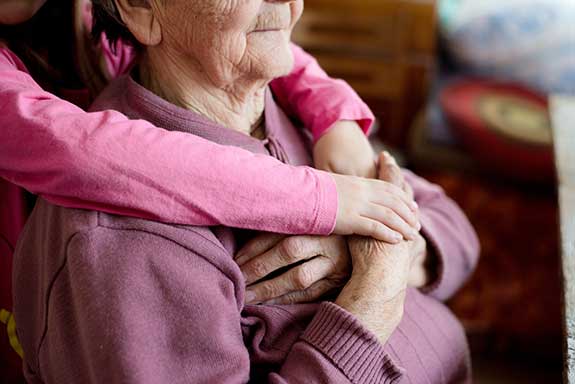
My parents worked full-time and had one Gen X child, me. I was diagnosed with arthritis at 1½ years old. Mom’s employer-sponsored insurance covered my frequent, costly treatments. But my parents couldn’t afford to miss work, so assistance was necessary. Mom researched options and hit the lotto by finding Tante Riet. I spent approximately 10-12 hours a day, five days a week, at Tante Riet’s home. On weekends and holidays, I was with my biological family. When I wasn’t in the hospital for arthritis treatments, this was my life until my teen years. Tante Riet, her husband, and their three daughters (teenagers when I was a baby) provided a traditional breadwinner-homemaker household, a stark contrast to my biological family home. I’ve always felt fortunate to have experienced both.
Tante Riet only cared for a few children other than her biological daughters, and she provided a loving home for all of us. She made three home-cooked meals every day, got us ready for school, provided transportation to and from school, helped us with our homework, and loved all of us. During school breaks, she took us to San Diego beaches, camping, to Sea World, to the Zoo, and to the Safari Park. When I was in the Los Angeles Children’s Hospital for months at a time, they visited me. At home in San Diego, while her teenagers played with the other children outside, Tante Riet sat with me during my proning therapy (described in my January 2026 article), singing as she rubbed my back. She would take me to medical appointments, and during physical therapy, she would do every exercise with me. She would have done that for any of us kids. To me, this was my second family. I was so lucky to have such great care and so much love in my life. It was a precious gift.
When I cried in pain or struggled with my arthritis, she’d hug me and say, “If I could take away your pain, I would.” Then I’d say it to other children: when a friend fell off their bike, I hugged them, and in a very serious tone, I told them, “If I could take away your pain, I would.” I didn’t really understand those words at such a young age, but I knew that’s what Tante Riet did. So I did it, too.
With her open mind, loving spirit, and great sense of humor, Tante Riet had a gift for connecting with anybody. I also admired her strength and determination to do what she felt was right. She often said, “We respect everyone. We may all look different, but inside we’re all the same.” In fact, when one of us kids would get mad at her, she would say, “You don’t have to like me, but you do have to respect me.”
Tante Riet grew up in the Netherlands. She was the youngest of nine children and just two years older than Anne Frank. She recounted her wartime experiences to her family. Stories of bombings, sneaking food to those most in need, boys taken off the streets for forced labor, German soldiers conducting door-to-door searches, and one hidden brother discovered by a foot left exposed.
After the war, Tante Riet worked as an au pair in England. Eventually, she moved back to the Netherlands, where she met her future husband. They moved to San Diego and started a new life together, where they had three daughters and raised several children.
In the mid-1990s, Tante Riet started displaying signs of Alzheimer’s disease. Yet her medical team didn’t diagnose her until years later, despite loved ones repeatedly reporting concerns. Shortly after her diagnosis, her husband passed. By then, most of her loved ones had moved away. I tried to take care of her as best I could. I felt it was the least I could do for Tante Riet. But I was working and a full-time student, and dealing with my own health issues; I couldn’t take care of her to the extent she needed. I knew she had to go where she could receive the best, most affordable care. Unfortunately for me, that wasn’t San Diego.
The family had a party before she moved, and my parents and I attended. For some reason, I didn’t understand what was happening; maybe I was in denial. Moving was definitely a secret from her (or she would never have left). I had to leave the party early and didn’t think much of it because I thought I’d see her the next day. I’ll never forget the moment we said goodbye.
I was standing at the door. I turned around to see her walking towards me. For a moment, with a clarity that suggested she’d never had Alzheimer’s, she said to me, “Why do I feel like this is the last time I’ll see you?” I was surprised and responded, “Don’t be silly. I’ll see you tomorrow, Tante Riet.” I hugged and kissed her for the last time in San Diego.
I thought about her constantly and tried to find a way to visit her. Financial and health-related obstacles stood in my way. I was heartbroken and anxious because I couldn’t afford to see her.
Then, in early 2008, a friend called and said, “I got you a plane ticket. Go see Tante Riet.” I was shocked, but not about to let that opportunity pass! I accepted the gift and booked the trip. I was finally going to see Tante Riet!
She could no longer manage her basic activities of daily living, such as toileting, bathing, and dressing. She lived in a memory care home near her daughter, who visited often and took her on regular outings, providing Tante Riet with a sense of normalcy. Seeing Tante Riet so well cared for comforted me.
Arriving at her new home, I remember it looked like a mansion. I appreciated that it felt more like a home than a hospital or facility. I was also glad it didn’t have that “facility stink” I expected. I noticed the residents walking by were smiling and seemed happy, which was another comfort to me. I realized this feeling of comfort would not have been Tante Riet’s experience when she visited me in the Los Angeles Children’s Hospital so many years ago, as my environment was certainly not that nice. I wondered if that was upsetting to her. If it was, I never saw it on her face.
We walked towards her area, a locked section for the residents’ safety. As we entered the room, among all the residents, the first person I saw – the only person I saw – was Tante Riet. After so many years, we had switched places; this time, I was the visitor.
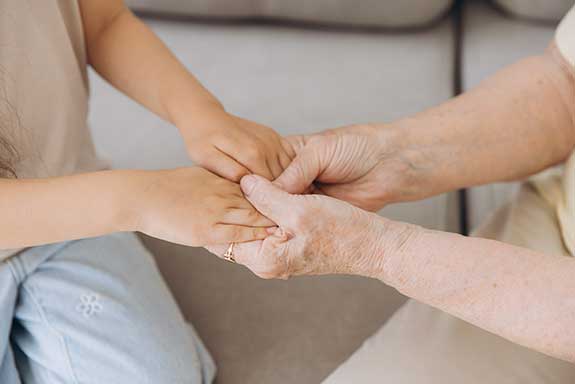
She didn’t notice us. She was sitting at the table with others, eating a bowl of soup. We walked up to her and said hello. It was as if time stood still. She turned around and looked up at me, and started crying. She stood up, hugged me, and said, “I want to go home.” It was all I could do not to cry. For the first time, I truly understood the words, “If I could take away your pain, I would.” I took her hand in mine, and we walked out.
During the rest of my visit with her, I remained close to her – sitting next to her, holding her hand – as if to make sure she was really there, and to let her know I was there. She didn’t remember me, but I didn’t care. We would go to Dunkin’ Donuts for a “lekker kop van koffie” and a donut. We also went to the grocery store and sang Klap eens in je handjes and other Dutch nursery rhymes.
On the last day I saw her, it was very difficult to maintain my composure. I knew it was the last time I would ever see her. We took pictures and sang more Dutch nursery rhymes. It was so hard for me to leave her. I knew she was in the best place, but I still wanted to take her home with me. I wondered if this was how she felt when she had to say goodbye to me at the hospital so many times. I walked out and directly into the nearest bathroom to be alone and cry. I let it all go, and I made my peace.
As the year went on, I had some major health issues. I wrote about them in my November 2024 article. Long story short, between June and October 2008, both of my artificial hips failed, requiring two revision surgeries. That November, while home alone, my newest hip collapsed while I was showering. I fell, hit my head, and shattered my pelvis, unsure if or when help would arrive. Here’s what else happened during that time:
October 12, 2008, was the day before my second hip surgery. I stayed home that night preparing for it. I went to bed early because I had to be at the hospital at o’dark-thirty A.M. I slept with my cell on my pillow to make sure I heard my alarm. Not long after I fell asleep, loud music woke me up. My roommate was a musician, and I assumed he was playing. But when I opened my eyes, I saw the light from my cell next to my face. The music wasn’t from my roommate, it was from my cell. I watched it play for the next minute or two, until it stopped, and then the room went dark again. It wasn’t my ringtone or an alarm; it was a tune I’d never heard before (or since). I certainly was awake then! I searched through my phone; no missed calls, texts, emails, or notifications of any kind. Looking through all the possible tunes on my phone, none of them matched the music I heard. It was difficult to fall back asleep. The next morning, Tante Riet’s daughter called to tell me she had passed that night. I can’t prove it, but I like to believe the music was Tante Riet saying goodbye.
Moments before my accident happened on November 30, 2008, I thought I smelled her perfume. I thought someone must have walked by outside my open window wearing the same perfume. As I lay there on the shower floor, singing, waiting for someone to find me, one of the songs I sang to myself was “Klap eens in je handjes.” Then the voice I heard telling me to “Wake up and scream” was Tante Riet’s voice. I thought I must have been delirious. But maybe she was watching over me and helping me again, like she always did. I choose to believe that, and I’m comforted by the idea that she’ll always watch over me.
The saying is true: If you can help just one, it can make all the difference in the world. Don’t ever doubt the impact you can have in this world by helping just one. (As the Dutch say, “Wie één mens redt, redt de hele wereld.”) Tante Riet, bedankt voor alles wat je voor me hebt gedaan en me hebt geleerd. Ik mis je elke dag en zal altijd van je blijven houden.

This article was originally published in the 2026 Women & LGBTQIA+ Visibility Issue of Las Vegas PRIDE Magazine, and can be read in its original format here.